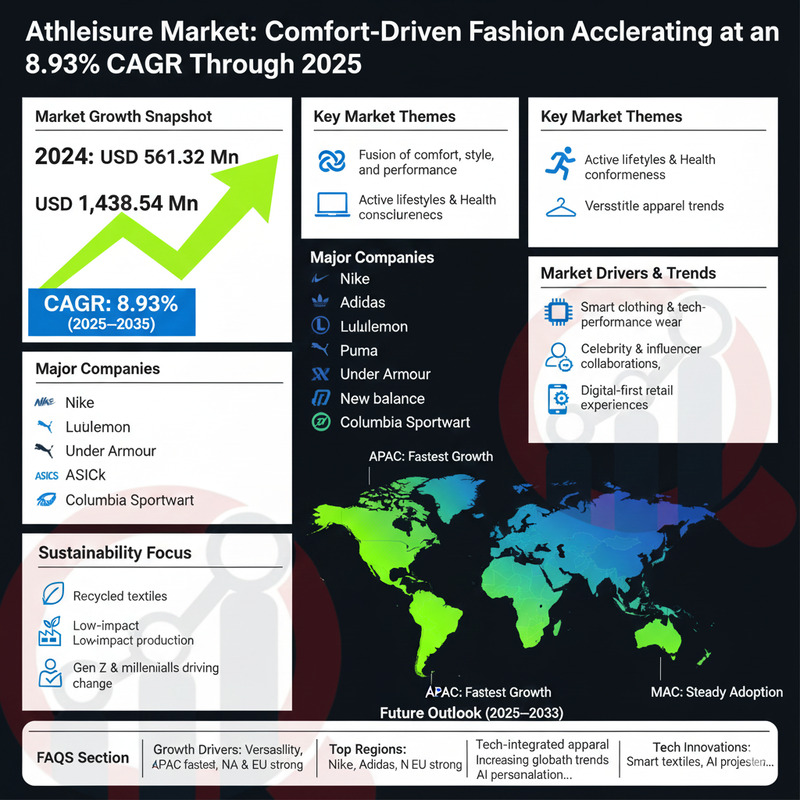
The global athleisure market demonstrates remarkable momentum, valued at 390.3 million USD in 2024 and projected to reach 425.0 million USD in 2025. Industry forecasts indicate the market will achieve substantial growth to 997.0 million USD by 2035, representing a compound annual growth rate (CAGR) of 8.90% during the forecast period from 2025 to 2035. This impressive expansion reflects the fundamental shift in consumer lifestyle preferences, where the boundaries between athletic wear and casual fashion continue to blur. The athleisure segment has transcended its origins as workout apparel to become a dominant force in everyday wardrobes, driven by remote work trends, health consciousness, and demand for versatile clothing that seamlessly transitions from gym to street to workplace.
The competitive landscape features both established sportswear giants and specialized athleisure innovators who continue to reshape market dynamics. Nike (US) and Adidas (DE) leverage their extensive global distribution networks and technological innovation capabilities to maintain market leadership, while Lululemon Athletica (CA) has built a cult following through premium positioning and community-driven marketing strategies. Puma (DE) and Under Armour (US) target performance-oriented consumers with technically advanced fabrics and athlete endorsements. Reebok (GB), New Balance (US), and ASICS (JP) bring heritage sportswear expertise combined with fashion-forward designs. Columbia Sportswear (US) expands athleisure offerings by integrating outdoor performance features into lifestyle apparel. These companies continuously invest in fabric technology, sustainable manufacturing, and digital engagement platforms to capture evolving consumer preferences and maintain competitive differentiation.
Regional analysis reveals distinct growth patterns across global markets, with North America representing the largest market share due to well-established fitness culture, high disposable incomes, and widespread acceptance of casual workplace attire. The region’s consumers demonstrate willingness to pay premium prices for innovative fabrics, sustainable materials, and brand heritage. Europe follows as a significant market characterized by fashion-conscious consumers who prioritize style alongside functionality, with Scandinavian and Western European countries leading adoption rates. The Asia-Pacific region emerges as the fastest-growing market, propelled by rising health awareness, expanding middle-class populations, urbanization trends, and increasing participation in fitness activities across China, India, Japan, and Southeast Asian nations.
Access Free Sample Copy – https://www.marketresearchfuture.com/sample_request/7412
Market segmentation by product type encompasses tops including t-shirts, tank tops, sports bras, and hoodies; bottoms such as leggings, joggers, shorts, and track pants; and outerwear featuring jackets, vests, and windbreakers. Leggings and yoga pants dominate women’s athleisure sales, while joggers and performance t-shirts lead men’s categories. The versatility of these garments allows consumers to style them for multiple occasions, maximizing wardrobe utility and justifying higher price points. Footwear represents a complementary category experiencing parallel growth as sneaker culture merges with athleisure trends.
End-user segmentation divides the market between women and men, with women historically representing the larger consumer base, particularly driving the premium athleisure segment pioneered by brands like Lululemon. However, the men’s athleisure market is experiencing accelerated growth as workplace dress codes relax and male consumers increasingly embrace comfortable, versatile clothing options. The gender-neutral and unisex product lines are gaining traction among younger demographics who value inclusive fashion and functional design over traditional gender-specific styling.
Distribution channel analysis highlights the multi-faceted retail landscape where brand-owned stores, specialty athletic retailers, department stores, and online platforms each serve distinct consumer needs. E-commerce channels are experiencing exponential growth, accounting for increasing market share as consumers appreciate detailed product information, customer reviews, home try-on options, and convenient shopping experiences. Direct-to-consumer strategies allow brands to control customer experience, gather valuable data insights, and capture higher profit margins. However, physical retail maintains importance for product touch-and-feel evaluation, immediate gratification, and experiential brand engagement through in-store fitness classes and community events.
Access Full Report – https://www.marketresearchfuture.com/reports/athleisure-market-7412
Key driving factors propelling market expansion include rising consumer preference for comfort and versatility, which fundamentally reshapes apparel purchasing decisions across demographics and geographies. The work-from-home revolution accelerated by global events has permanently altered dress code expectations, with athleisure becoming acceptable in professional video conferences and hybrid office environments. Growing health and wellness consciousness drives consumers toward active lifestyles, increasing demand for functional athletic apparel that supports fitness routines. Social media influence and celebrity endorsements create aspirational appeal, with influencers showcasing athleisure styling possibilities that inspire followers to invest in similar wardrobes.
Market trends reshaping the industry include integration of sustainable materials as environmentally conscious consumers demand transparency in supply chains and eco-friendly fabric alternatives. Brands are incorporating recycled polyester, organic cotton, bamboo fibers, and innovative materials like seaweed-based textiles to reduce environmental impact. Smart textiles embedded with moisture-wicking properties, temperature regulation, antimicrobial treatments, and even biometric sensors represent the technological frontier, appealing to tech-savvy consumers seeking performance optimization. Customization and personalization services allow consumers to select colors, patterns, and fits that reflect individual style preferences, creating emotional connections with brands. Gender-neutral designs and inclusive sizing expand market reach to underserved consumer segments, while collaborations between athleisure brands and high-fashion designers elevate category prestige.
The escalating geopolitical tensions involving Iran, Israel, and USA significantly impact the athleisure market through multiple supply chain vulnerabilities. Textile manufacturing concentrated in Asian production hubs relies heavily on maritime shipping routes that transit conflict-affected regions, with delays in Red Sea and Strait of Hormuz passages creating inventory shortages during peak selling seasons. Raw material costs for synthetic fabrics derived from petrochemical feedstocks experience volatility as energy markets react to Middle Eastern instabilities, compressing profit margins for manufacturers unable to immediately pass costs to price-sensitive consumers. Shipping container shortages and elevated freight rates force brands to choose between air freight expenses that erode profitability or extended delivery timelines that risk losing sales to competitors with better inventory availability. The uncertainty surrounding these disruptions complicates seasonal planning, promotional calendars, and new product launches that require precise timing for market success.
GLOBAL SUPPLY CHAIN & MARKET DISRUPTION ALERT
Escalating geopolitical tensions in the Middle East, particularly around the Strait of Hormuz and the Red Sea, are creating significant disruptions across global energy, chemicals, and logistics markets. Critical shipping corridors are under pressure, with major oil, LNG, petrochemical, and raw material flows at risk, triggering supply chain delays, freight cost surges, insurance withdrawals, and heightened price volatility. These disruptions are increasing operational risks and cost uncertainties for industries dependent on global trade routes and energy-linked feedstocks.
FAQs
Q1: How are athleisure brands addressing sizing inclusivity and what impact does this have on market growth?
Leading athleisure brands are expanding size ranges to accommodate diverse body types, with several major companies now offering extended sizing from XXS to 4XL or beyond. This inclusivity initiative not only addresses social responsibility but also unlocks significant revenue potential, as industry estimates suggest the plus-size athleisure segment alone could represent 20-25% of total market value by 2030, driving innovation in fabric engineering to ensure performance consistency across all sizes.
Q2: What role does rental and resale play in the athleisure market’s circular economy transformation?
The athleisure resale market is experiencing rapid growth, with dedicated platforms facilitating peer-to-peer transactions and some brands launching official pre-owned programs. Industry data indicates the secondhand athleisure market is growing at twice the rate of primary sales, appealing particularly to Gen Z consumers who prioritize sustainability and value. This trend is prompting brands to design for durability and longevity, knowing products may serve multiple owners throughout their lifecycle.
Read Our Related Report:
Germany Athleisure Market –
https://www.marketresearchfuture.com/reports/germany-athleisure-market-46380
North America Athleisure Market –
https://www.marketresearchfuture.com/reports/north-america-athleisure-market-46382
Europe Athleisure Market –
https://www.marketresearchfuture.com/reports/europe-athleisure-market-46385
India Athleisure Market –
https://www.marketresearchfuture.com/reports/india-athleisure-market-46386
China Athleisure Market –
https://www.marketresearchfuture.com/reports/china-athleisure-market-46387