- What Are Biomass Pellets?
- Key Market Drivers
- 1. Rising Energy Prices and Energy Security Concerns
- 2. Government Regulations Favoring Renewable Energy
- 3. Increasing Environmental Awareness
- 4. Technological Innovations in Biomass Processing
- 5. Growing Industrial Applications
- Market Segment Insights
- By Source: Industrial Waste & Co-product Dominates, Energy Crops Surge
- By Type: Wood Pellets Lead, Torrefied Pellets Emerge
- By Application: Power Generation Leads, Residential Heating Grows Fast
- Regional Market Overview
- North America — Renewable Energy Leader
- Europe — Sustainable Energy Transition Hub
- Asia-Pacific — Fastest-Growing Region
- Middle East and Africa — Untapped Potential
- Competitive Landscape
- Future Outlook
As the world accelerates its transition away from fossil fuels, biomass pellets have emerged as one of the most practical, scalable, and readily deployable renewable energy solutions available today. Compact, energy-dense, and derived from organic materials that would otherwise go to waste, biomass pellets are quietly powering homes, factories, and utility-scale power plants across the globe — playing a pivotal role in the decarbonization strategies of nations from North America to Asia-Pacific.
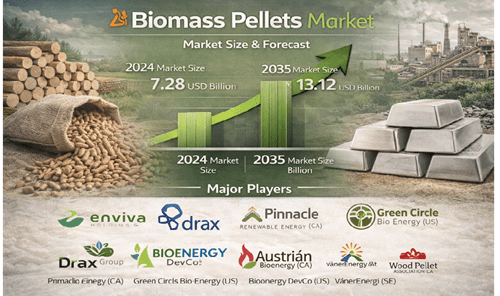
According to the global biomass pellets market was valued at USD 7.28 billion in 2024 and is projected to grow from USD 7.681 billion in 2025 to USD 13.12 billion by 2035, advancing at a steady compound annual growth rate (CAGR) of 5.5% during the forecast period from 2025 to 2035.
What Are Biomass Pellets?
Biomass pellets are small, cylindrical units of compressed organic matter — typically produced from wood residues, agricultural waste, energy crops, food waste, or industrial co-products. The pelletization process involves drying, grinding, and compressing raw biomass under high pressure, resulting in a standardized, energy-dense fuel that is easy to handle, transport, and store.
Their uniform shape and composition make biomass pellets highly compatible with automated feeding systems in power plants and heating installations, enabling seamless integration into existing energy infrastructure. Crucially, when sourced from sustainably managed forests or agricultural residues, biomass pellets are considered carbon-neutral over their lifecycle — making them a key tool in meeting global net-zero targets.
Key Market Drivers
1. Rising Energy Prices and Energy Security Concerns
Volatile fossil fuel prices and growing concerns about energy security are compelling governments, industries, and households to explore stable, domestically producible energy alternatives. Biomass pellets offer a predictable, competitively priced energy source that can be produced from locally available feedstocks, reducing dependence on imported fossil fuels. Market analysis indicates that the biomass energy sector could expand its share of the global energy mix by approximately 15% over the next five years, driven in large part by this economic and strategic imperative.
2. Government Regulations Favoring Renewable Energy
Supportive policy frameworks are among the most powerful drivers shaping the biomass pellets market. Governments across the EU, the US, the UK, Japan, South Korea, and beyond have implemented renewable energy mandates, carbon reduction targets, and financial incentive schemes — including subsidies, tax credits, and Renewable Obligation Certificates — that directly stimulate biomass pellet production and consumption. Biomass pellet consumption is projected to rise by as much as 30% over the next decade, driven largely by this expanding regulatory support. Crucially, biomass is recognized under frameworks such as the EU Renewable Energy Directive as a qualifying renewable energy source, unlocking substantial public and private investment.
3. Increasing Environmental Awareness
Growing public and corporate consciousness around climate change and carbon emissions is driving a broad-based shift toward sustainable energy choices. Biomass pellets, derived from organic materials and combusted with significantly lower net carbon emissions than coal or natural gas, align strongly with sustainability mandates adopted by corporations, municipalities, and institutional energy buyers. The biomass sector is projected to grow at approximately 8% annually in response to this rising demand for cleaner energy alternatives.
4. Technological Innovations in Biomass Processing
Advances in pelletization technology, feedstock pre-treatment, and combustion systems are continuously improving the efficiency, quality, and cost-competitiveness of biomass pellets. Enhanced pelletizing machinery, improved drying technologies, and the development of torrefied pellets — a thermally treated variant with higher energy density and superior weather resistance — are expanding the range of viable feedstocks and applications. These technological improvements are projected to drive a 20% increase in production capacity by 2026, attracting new market entrants and intensifying competition across the value chain.
5. Growing Industrial Applications
The industrial sector’s appetite for biomass pellets is expanding as manufacturers and utilities seek to reduce their carbon footprints while maintaining reliable energy supply. Power generation, industrial process heating, cement production, and pulp and paper manufacturing are among the sectors driving increased biomass adoption. Industrial consumption of biomass pellets is expected to rise by approximately 25% in the coming years, as large-scale operators progressively substitute coal and natural gas with biomass in their energy systems.
Download Report Sample Copy with TOC: https://www.marketresearchfuture.com/sample_request/8172
Market Segment Insights
By Source: Industrial Waste & Co-product Dominates, Energy Crops Surge
The market is sourced from a diverse range of feedstocks including Industrial Waste & Co-products, Agriculture Residue, Food Waste, Energy Crops, Virgin Lumber, and Others. Industrial Waste & Co-products currently holds the largest share, leveraging the circular economy model by transforming manufacturing and processing residues — from sawmill offcuts to food processing waste — into high-value energy carriers. This segment’s dominance reflects its established supply chain infrastructure and cost advantages.
Energy Crops — purpose-grown species such as miscanthus, switchgrass, and short-rotation coppice willow — represent the fastest-growing source segment. Driven by agricultural innovation, government incentives for dedicated energy crop cultivation, and their potential for very high biomass yields per hectare, energy crops are rapidly gaining ground as a strategically important and sustainable feedstock for the biomass pellet industry.
By Type: Wood Pellets Lead, Torrefied Pellets Emerge
Wood Pellets are the dominant product type by a significant margin, valued at USD 3.0 billion in 2024 and projected to reach USD 5.5 billion by 2035. Their widespread adoption stems from decades of proven performance in residential heating and industrial power generation, a well-established international supply chain, and compatibility with existing biomass combustion infrastructure. Wood pellets are primarily sourced from timber industry residues and sustainably harvested forest biomass.
Torrefied Pellets represent the most exciting emerging product category. The torrefaction process — a mild thermal pre-treatment at temperatures between 200°C and 300°C — substantially increases energy density, reduces moisture absorption, and improves grindability, making torrefied pellets functionally closer to coal. This makes them particularly attractive for large-scale co-firing at coal power plants with minimal modifications to existing equipment. As torrefaction technology matures and production costs decline, this segment is expected to gain rapid market share through 2035.
Agri Pellets, produced from agricultural residues such as rice husks, straw, and sugarcane bagasse, are the fastest-growing type by adoption rate, fueled by the need to manage agricultural waste sustainably while creating a valuable energy product.
By Application: Power Generation Leads, Residential Heating Grows Fast
Power Generation commands the largest application share in the biomass pellets market, driven by large-scale utility co-firing programs and dedicated biomass power plants that consume millions of tonnes of pellets annually. This segment is anchored by utility-scale operators in the UK, EU, Japan, and South Korea who have committed to coal phase-out timelines and are using biomass as a transitional or long-term renewable energy source.
Residential Heating is the fastest-growing application, propelled by rising consumer interest in sustainable home heating solutions. Modern pellet stoves and boilers deliver convenience, automation, and heating performance comparable to gas systems, while qualifying for renewable heat incentives in many markets. The growing accessibility of pellet-based heating systems and the expansion of pellet retail networks are steadily bringing biomass heating into mainstream residential use across Europe and North America.
Buy Now: https://www.marketresearchfuture.com/checkout?currency=one_user-USD&report_id=8172
Regional Market Overview
North America — Renewable Energy Leader
North America is the largest regional market, accounting for approximately 45% of global biomass pellet demand. The United States is the world’s largest exporter of wood pellets, supplying major markets in the UK, EU, and Asia-Pacific. Canada is also a significant producer, with British Columbia a major pellet production hub. Regulatory support for sustainable forestry practices, long-term export contracts with European and Japanese utilities, and a growing domestic market all underpin the region’s market leadership.
Europe — Sustainable Energy Transition Hub
Europe holds around 30% of global market share and is the world’s largest importer and consumer of biomass pellets for power generation. The EU’s Renewable Energy Directive and national carbon reduction commitments have created enormous sustained demand, particularly in the UK, Germany, the Netherlands, Belgium, and the Nordic countries. The transition of major coal plants to biomass — most notably the UK’s Drax Power Station — exemplifies the region’s commitment to biomass as a bridge fuel in the energy transition.
Asia-Pacific — Fastest-Growing Region
The Asia-Pacific region accounts for approximately 20% of global market share and is growing at the fastest pace. Japan and South Korea are the primary demand centers, both having established significant biomass power generation capacity underpinned by long-term supply agreements with North American and Southeast Asian pellet producers. Government-backed renewable energy feed-in tariff schemes in both countries have been transformative in stimulating biomass demand. China is also emerging as both a producer and consumer of biomass pellets, with strong government support for rural biomass energy programs.
Middle East and Africa — Untapped Potential
The Middle East and Africa currently hold approximately 5% of global market share, but represent a significant long-term growth frontier as energy needs rise and governments explore biomass as part of diversified renewable energy strategies. South Africa, in particular, is beginning to develop domestic biomass supply chains, leveraging its agricultural residue base and forestry sector.
Competitive Landscape
The biomass pellets market is served by a mix of large integrated producers, regional specialists, and emerging market players. Key companies profiled in the include Enviva Holdings (US), Drax Group (UK), Pinnacle Renewable Energy (Canada), Green Circle Bio Energy (US), Bioenergy DevCo (US), Austrian Bioenergy (Austria), VänerEnergi (Sweden), and the Wood Pellet Association of Canada.
The competitive landscape has been highly active, with several landmark developments shaping the market through 2024–2025. Drax Group completed its acquisition of Pinnacle Renewable Energy, significantly expanding its global pellet supply chain. Enviva secured USD 300 million in new financing to support operations and growth, and launched a new production facility in Mississippi. Meanwhile, long-term supply agreements between North American producers and Asian utilities — including partnerships with J-Power, Sumitomo Corporation, and Mitsui & Co. — reflect the deepening strategic ties between pellet exporters and the Asian power generation market. In the UK, new regulatory approvals for biomass plant construction in Yorkshire signal continued institutional support for the sector.
Future Outlook
The biomass pellets market’s trajectory toward USD 13.12 billion by 2035 is grounded in some of the most durable structural forces in the global energy landscape: decarbonization policy, energy security imperatives, and the practical need for dispatchable renewable energy in a grid increasingly populated by intermittent solar and wind power.
Key opportunities on the horizon include the commercialization of advanced torrefied pellet supply chains, the development of biomass-with-carbon-capture-and-storage (BECCS) projects that could make biomass energy carbon-negative, expansion of biomass markets in Southeast Asia and Africa, and growing partnerships between the agricultural sector and pellet producers for sustainable, waste-derived feedstock supply.
Biomass pellets occupy a unique and increasingly critical position in the global renewable energy ecosystem — offering a reliable, carbon-managed, and infrastructure-compatible alternative to fossil fuels for power generation, industrial heating, and residential use. The market’s projected growth to USD 13.12 billion by 2035 reflects both the urgency of the global energy transition and the practical advantages that biomass pellets offer as a proven, scalable clean energy solution.
For more insights on Market, visit the Market Research Future page and explore detailed market analysis, forecasts, and company strategies.
High Purity Gaseous Helium Market |Japanies |French |German |Spanish |Korean |China
Toner Resin Market |Japanies |French |German |Spanish |Korean |China
Engineered Wood Product Market |Japanies |French |German |Spanish |Korean |China
High Purity Hydrogen Market |Japanies |French |German |Spanish |Korean |China
Fiberglass Product Market |Japanies |French |German |Spanish |Korean |China
High Strength Laminating Adhesives Market |Japanies |French |German |Spanish |Korean |China
High Temperature Gasket Material Market |Japanies |French |German |Spanish |Korean |China
High Temperature Polymer Market |Japanies |French |German |Spanish |Korean |China
High Temperature Silicone Market |Japanies |French |German |Spanish |Korean |China
For more insights on Market, visit the Market Research Future page and explore detailed market analysis, forecasts, and company strategies.
Specialty Fuel Additives Market